Safety compliance is rarely lost all at once. It erodes one missed signature, one misplaced sheet, one talk that happened but was never logged. By the time an audit or incident investigation exposes the gap, it can be difficult to reconstruct what actually occurred. Digital toolbox talks address this problem not by making safety communication more complex, but by making the record of it more reliable.
Understanding how compliance actually breaks down on paper, and what specifically closes those gaps digitally, makes it easier to see where a platform delivers real value rather than just a different format for the same problems.
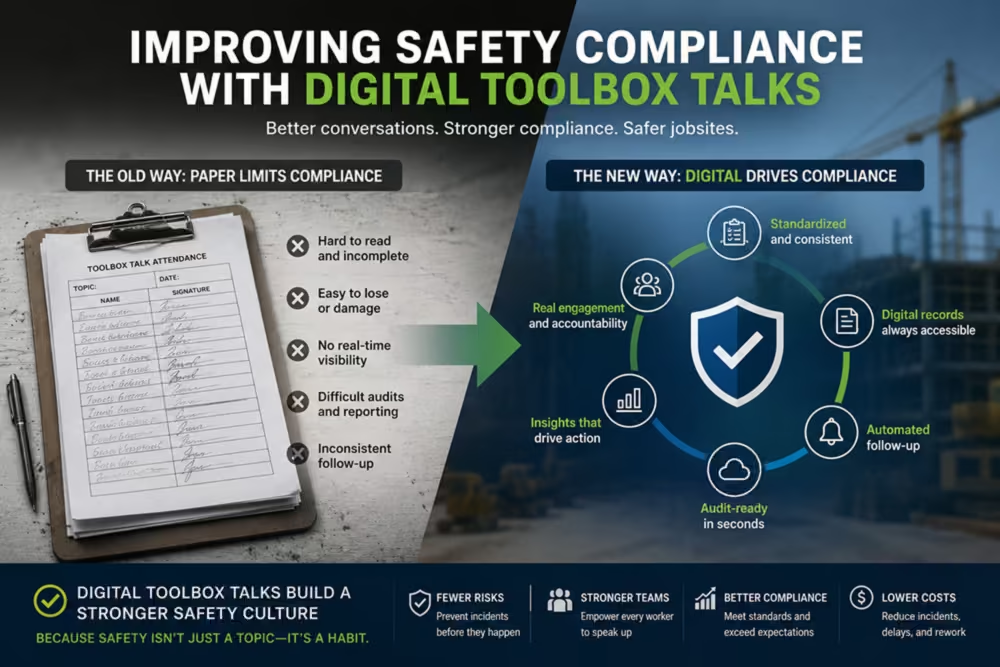
Where Paper-Based Compliance Breaks Down
Paper toolbox talk programs tend to fail in predictable ways. Sheets get left in trucks or job trailers instead of making it back to the office. Signatures are illegible or missing entirely. Topics get repeated because nobody can quickly check what a crew already covered. And when an incident happens, safety teams sometimes spend hours searching through bins of paperwork to confirm whether a relevant talk took place at all.
None of this usually reflects a lack of effort by supervisors. It reflects the limits of a paper process spread across multiple crews, sites, and shifts. The talks may genuinely be happening. The problem is that nobody can prove it later, which in a compliance context comes uncomfortably close to it not happening at all.
The Mechanisms That Close the Gap
Digital toolbox talk platforms address these failure points through a few specific mechanisms, each targeting a particular weakness in the paper process.
Time-stamped, location-tagged records remove the ambiguity around whether and when a talk occurred. Instead of a handwritten date that may or may not be accurate, the system logs the exact time the talk was delivered and, often, the device’s location, creating a record that holds up under scrutiny rather than one that relies on a supervisor’s memory weeks later.
Digital attendance, whether captured by signature, QR scan, or roster check-off, ties specific workers to a specific talk in a way that is far harder to dispute than a paper sign-in sheet that could have been filled out by anyone, at any time, for any reason.
Centralized content control ensures every supervisor is delivering the current, approved version of a topic. When a procedure changes after an incident or new regulation, the update is pushed once and reflected everywhere, rather than depending on someone manually redistributing a revised printout to every site.
Searchable records turn compliance documentation from a defensive afterthought into a usable resource. A safety manager can pull every talk delivered to a specific crew, on a specific topic, within a specific date range in minutes, which matters as much for internal tracking as it does for satisfying an external auditor.
Turning Mechanisms into Practical Improvement
Having the right features available is not the same as using them effectively. Organizations that see real compliance gains tend to follow a few consistent habits, running alongside each other rather than in any particular order.
They schedule topics in advance rather than leaving selection to chance each morning. A rolling calendar tied to project phase, season, or recent incident trends ensures coverage is deliberate rather than repetitive or reactive.
They review completion data regularly instead of only looking at it after something goes wrong. A quick weekly check of which crews have and have not logged a talk catches small gaps before they become a pattern.
They standardize the attendance method by crew type rather than leaving it inconsistent. A stable crew might stick with roster check-off, while a site with heavy subcontractor turnover may get more reliable results from QR check-in, where each worker confirms their own presence.
They close the loop on hazards raised during a talk. If a worker flags a concern, that note should route to someone who can act on it, and the resolution should be visible back in the record. A platform that only captures attendance, without surfacing what was actually discussed, misses part of what compliance is meant to demonstrate.
They also treat the platform itself as part of onboarding for new supervisors, not an afterthought. A foreman who learns the system on day one, rather than being handed a login and figuring it out mid-shift, is far less likely to fall back on workarounds that quietly undermine the compliance record later.
Compliance as a Byproduct, Not a Burden
The strongest digital toolbox talk programs treat compliance as a byproduct of doing the work well, not as a separate task layered on top of it. When a supervisor delivers a talk and captures attendance in the normal course of starting the day, the compliance record is simply what gets produced along the way. The mechanisms described above, timestamps, digital attendance, centralized content, searchable reporting, only deliver that result when the habits around them are in place too.
That shift matters because compliance efforts that depend on extra discipline tend to fade under field pressure. Compliance that is built into a workflow people are already following tends to hold up, audit after audit, project after project.
If you’re looking to strengthen safety compliance without adding administrative weight to your supervisors, MobileFrame’s Toolbox Talk Solution is built to make accurate documentation a natural part of the daily talk, not an extra step afterward.