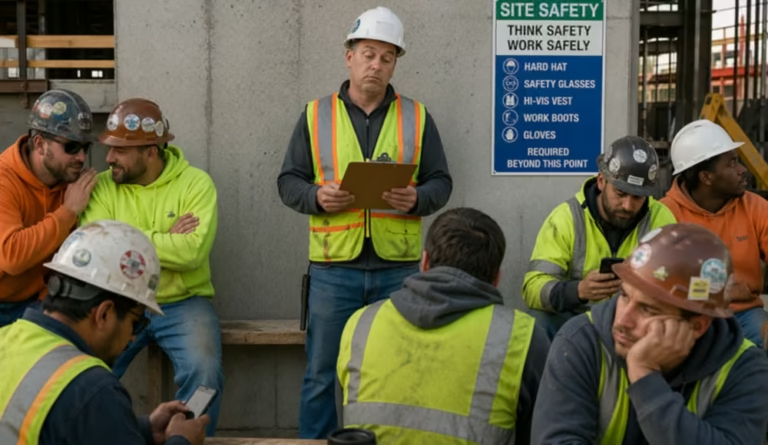
Toolbox talks are a routine part of field operations, but their impact depends heavily on how consistently they are executed and how well they are documented. In many organizations, the conversation itself happens reliably, but the process around it breaks down. Attendance is reconstructed later, documentation is incomplete, and issues raised during the discussion are not always tracked to resolution.
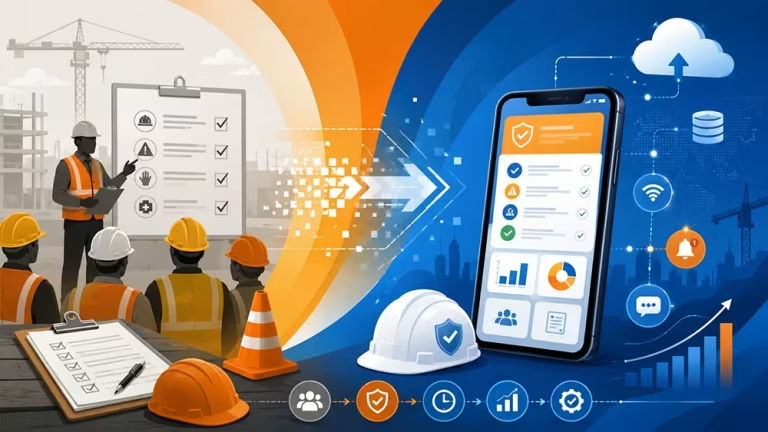
A toolbox talk app addresses these gaps by changing when and how information is captured. Instead of treating documentation as a separate administrative task, it becomes part of the talk itself. That shift has broader implications than simply replacing paper. It changes how safety is monitored, how issues are addressed, and how accountability is maintained across crews.
Where Traditional Toolbox Talks Break Down
Before discussing the benefits of toolbox talk apps, it is important to understand the gaps in traditional toolbox talk processes. Most breakdowns in toolbox talk programs are not caused by lack of effort. They stem from timing, fragmentation, and administrative burden.
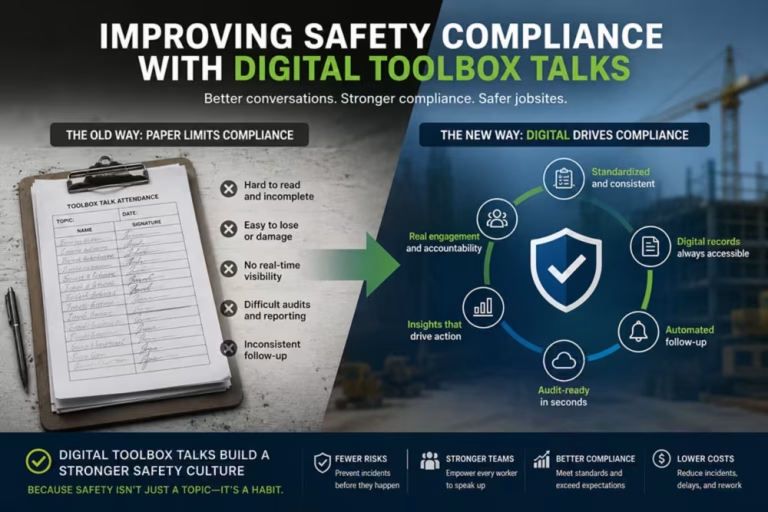
With a spreadsheet or paper-based process, documentation is often completed after the fact. A foreman may run a strong discussion in the morning, then fill out the form later in the day or even at the end of the week. At that point, details are reconstructed from memory. Attendance may be estimated. Notes are abbreviated or omitted. If a form is misplaced or delayed, there may be no record at all. Paper work needs to be stored, can be lost or difficult to retrieve when needed.
This creates a situation where the conversation happens, but the organization cannot reliably prove what occurred. That gap becomes visible during audits, incident reviews, internal evaluations, when leadership needs to understand whether safety procedures were followed consistently. If litigation occurs, documentary proof is critical.
A toolbox talk app addresses this by shifting documentation into the moment the talk occurs. This change reduces reliance on memory and removes the lag between execution and record-keeping, which is where most inconsistencies originate.
Visibility That Arrives in Time to Matter
In many organizations, visibility into toolbox talks is limited and often arrives too late to influence outcomes. Reports are compiled after forms are submitted, reviewed days or weeks later, and used primarily for record-keeping rather than active management. Creating reports from paper forms or spreadsheets can also be cumbersome and time consuming.
When documentation is captured at the time of the talk and made available immediately, the timing of that visibility changes. Instead of reviewing last week’s activity, supervisors and safety managers can identify gaps the same day. If a crew misses a talk or submits incomplete information, that issue can be addressed while the job is still active.
This shift affects how safety is managed. It allows organizations to intervene earlier, before missed steps become patterns. It also creates clearer expectations, since crews know that completion is visible and evaluated in near real time rather than retrospectively.
The benefit is not simply “more visibility,” but visibility that is aligned with the pace of field operations.
Accountability That Reflects What Actually Happened
Accountability is often weakened by the way documentation is handled. When records are created after the fact, there is room for inconsistency. Attendance may be filled in from memory. Missing details may go unnoticed. Over time, the record becomes less reliable as a reflection of what actually occurred.
When documentation is completed during the toolbox talk itself, that dynamic changes. Participation is recorded while the crew is present, and discussions are captured while they are still fresh. This reduces the opportunity for missing information and makes the record more closely match the actual event.
As a result, accountability becomes tied to real actions rather than after-the-fact reporting. Supervisors are not being asked to recall what happened earlier in the day or week. Instead, they are completing the process as part of the work itself. That shift tends to improve both completeness and accuracy, not because of stricter enforcement, but because the process aligns more naturally with how the work is performed.
Consistency Across Crews and Job Sites
One of the persistent challenges in toolbox talk programs is variation between crews. Different supervisors emphasize different topics, document at different levels of detail, and follow different routines. Even when expectations are clearly defined, execution can vary widely from one job site to another.
A toolbox talk app introduces a more consistent structure by embedding expectations into the process itself. The goal is not to standardize the conversation, which still needs to reflect the conditions of each job site, but to standardize the way the talk is conducted and recorded.
This distinction matters. Crews can still discuss the specific hazards they face that day, but the underlying process remains consistent across the organization. Over time, this reduces variability in documentation quality and ensures that core requirements are met regardless of who is leading the discussion. The benefit is a more reliable baseline across crews, which makes it easier to evaluate performance and identify areas that need attention.
Faster Follow-Through on Field Issues
Toolbox talks often surface practical concerns: equipment that needs attention, conditions that present a risk, or processes that are not working as intended. In paper-based systems, these issues are easy to lose track of. They may be noted on a form, but there is often no clear path from identification to resolution.
When issues are captured as part of a structured process and remain visible after the talk, they are more likely to be followed through. Instead of being isolated notes, they become items that can be tracked and revisited. This creates a more complete cycle. The talk is not just a forum for discussion, but a point of entry into a broader process where concerns are acknowledged and addressed. Over time, this improves responsiveness, since issues are less likely to be forgotten or deferred indefinitely.
Stronger Audit Readiness
Audits rarely fail because organizations ignore safety. They fail because documentation is incomplete or inconsistent. The issue is often less about whether safety procedures were discussed and more about being able to prove it.
A toolbox talk app ensures records are created in real time and stored in a centralized system. When documentation is needed, it can be retrieved immediately without reconstructing events from scattered paperwork. This reduces stress on both field and office teams and allows safety leaders to focus on improving operations instead of preparing for audits.
Less Administrative Friction for Field Teams
Spreadsheets or paper-based toolbox talks introduce a layer of administrative work that competes with operational priorities. Forms need to be completed, stored, submitted, and sometimes re-entered into other systems. This work often occurs after the talk, when crews are focused on other tasks.
By integrating documentation into the talk itself and eliminating the need for separate handling of forms, that administrative burden is reduced. Supervisors are not managing a second process after the conversation ends. Instead, completion and documentation occur together.
This has two effects. First, it reduces the time spent on administrative follow-up. Second, it lowers the likelihood of incomplete or delayed submissions, since there is no separate step that can be postponed or overlooked. The benefit is not just efficiency, but a cleaner alignment between the work being done and the records being created.
Using Toolbox Talk Data to Improve Safety Over Time
When toolbox talks are documented consistently and in a timely manner, they begin to produce a usable body of data. Patterns that are difficult to see in isolated forms become clearer when viewed across crews, job sites, and time periods.
Recurring issues can be identified more quickly. Missed talks or delayed completion can be addressed before they become systemic. Trends in the types of hazards discussed can inform broader safety initiatives.
This allows organizations to move beyond reactive management. Instead of relying solely on incident reports or periodic reviews, they can use day-to-day activity to guide decisions. The result is a more continuous approach to improvement, where adjustments are made based on what is actually happening in the field.
A Practical Shift in How Safety Is Managed
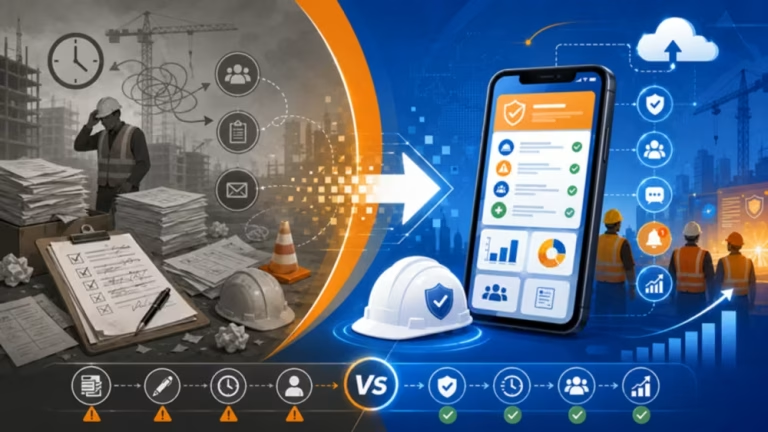
Moving from spreadsheets or paper-based toolbox talks to a digital process is not simply a change in format. It alters the relationship between the conversation, the documentation, and the organization’s ability to act on what is learned.
When documentation is timely, consistent, and tied closely to the work itself, it becomes a more reliable foundation for managing safety. Visibility improves not just in volume, but in usefulness. Accountability becomes more closely aligned with actual behavior. Issues raised in the field are more likely to be addressed. For organizations looking to strengthen their toolbox talk programs, shifting to a toolbox talk app can have a meaningful impact.