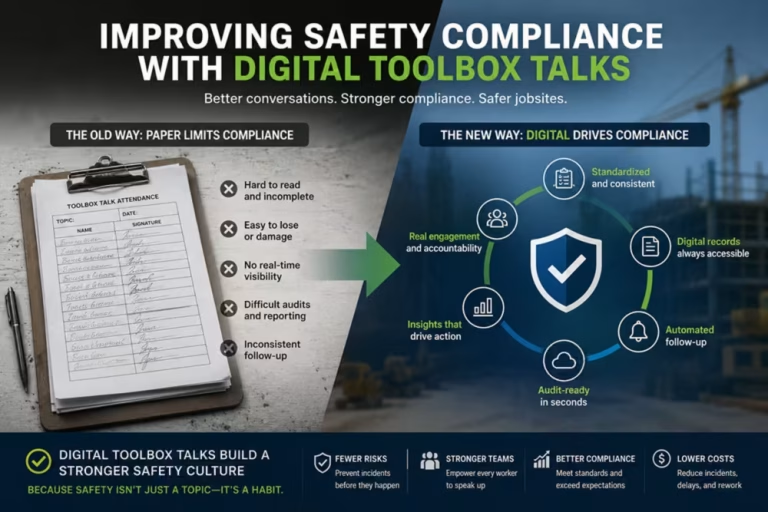
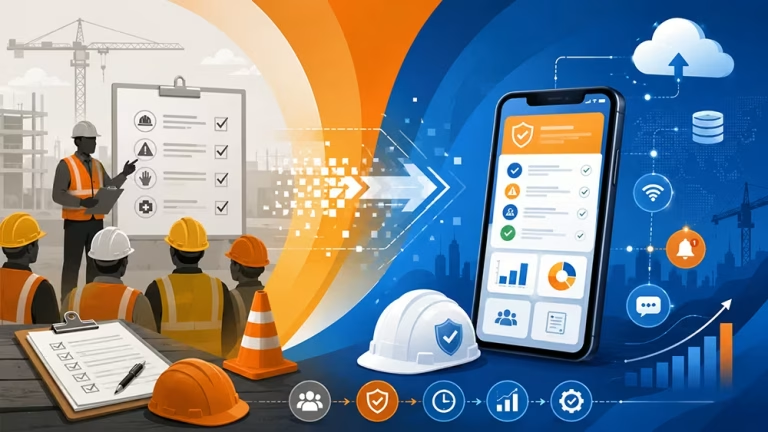
The choice between a toolbox talk app and paper forms is rarely framed as the consequential decision it actually is. On the surface, both approaches appear to accomplish the same task: a safety topic gets covered, attendance gets recorded, and the crew goes to work.
The difference is in what happens around that process, and how consistently it happens across dozens of crews, hundreds of workers, and thousands of toolbox talks over the course of a project or a year. When those variables are examined closely, the comparison stops being a matter of preference and becomes a question of whether the safety program is functioning as intended.

What Paper Forms Do Well and Where They Break Down
Paper forms have legitimate advantages that are worth acknowledging honestly. They require little setup, minimal training, and no dependency on user adoption beyond a printed sheet and a pen. A supervisor can conduct a toolbox talk quickly in the field without worrying about logins, devices, or process changes. For very small operations, single-site contractors, or organizations with limited safety documentation requirements, paper can be sufficient.
The problems begin at scale and over time. A single misplaced sign-in sheet is a minor inconvenience. Across a workforce of fifty or a hundred field workers, operating across multiple sites and shifts, the cumulative documentation gaps that paper produces are rarely minor. Sheets get left in trucks, damaged by weather, submitted incomplete, or never turned in at all. When those gaps surface during an audit or an incident investigation, reconstructing the record is often impossible rather than merely inconvenient.
Paper also offers no enforcement mechanism. Whether a talk happened, who attended, and whether the topic covered was appropriate for the work being performed that day all depend entirely on individual behavior with no system support. A supervisor who is thorough produces a reliable record. A supervisor who is rushed, disorganized, or simply having a bad week produces gaps. The paper form itself has no way to distinguish between the two.
What a Toolbox Talk App Changes Structurally
The most important thing a toolbox talk app changes is not the toolbox talk itself. It’s the infrastructure surrounding it. The talk still happens in the field, led by a supervisor, with a crew that needs to engage with the content. What changes is everything that happens before and after.
Before the talk, an app provides a structured list of topics instead of a stack of printed pages that might not be current, relevant, or easy to locate. A supervisor can search by hazard type, trade, or task and quickly find content that applies to the work the crew is actually performing that morning. That relevance matters. It directly affects whether workers engage with the discussion or simply wait for the meeting to end.
After the talk, the record is created in the system at the moment of completion rather than existing as a physical document that must survive the workday and eventually make its way into a filing system. Attendance is captured digitally, whether through a roster checkoff, a signature on the supervisor’s screen, or a QR code scan on workers’ own phones. The record is timestamped, associated with a specific crew and user, and immediately available for reporting without additional processing.
That shift from a physical document to a live digital record is what makes the comparison more than a matter of convenience. A safety manager overseeing multiple sites with paper forms has only a partial view of what is happening. A safety manager using a digital toolbox talk platform can see activity in real time and act on problems before gaps become patterns.
Toolbox Talk Attendance and Accountability
On paper, confirming who attended a toolbox talk means trusting that the sign-in sheet was passed around, that everyone present actually signed it, and that the sheet itself made it to wherever records are stored. Each step is a potential failure point, and none of them has a built-in safeguard if something goes wrong.
A toolbox talk app replaces that chain of manual steps with a structured workflow. Attendance is recorded as part of the delivery process rather than as a separate administrative task competing with everything else a supervisor is managing. For larger crews, QR code check-in allows workers to record their own attendance directly, removing the supervisor from the data entry process and creating a more accurate individual-level record.
The accountability difference extends beyond individual talks. With paper, identifying which workers have not received a specific topic, or which crews have fallen behind on required training, often requires someone to manually review stacks of forms and compile the information by hand. With a digital platform, that analysis is available on demand. A safety manager can pull a report showing exactly which workers have not completed a particular topic, filter by site or crew, and follow up with targeted precision instead of reconstructing attendance from incomplete records.
Safety Briefing Compliance and Audit Readiness
The compliance implications of the paper versus digital comparison become most visible when something goes wrong. During an OSHA inspection, a workers’ compensation claim, or a post-incident review, the ability to produce a clear, complete, and credible record of safety training is not a secondary concern. It is often central to how the organization is evaluated.
Paper records create a structural problem in those situations. Even when forms were completed diligently, assembling a coherent record across a workforce of any size takes time and effort. Forms may be stored in different locations, filed inconsistently, or partially illegible. The resulting documentation, even if substantially complete, can appear disorganized in ways that undermine credibility.
A digital toolbox talk platform produces audit-ready documentation as a byproduct of normal program operation. Every talk that was conducted, every worker who attended, and every topic that was covered is stored in a searchable, reportable format. Generating a compliance report for a specific time period, site, crew, or individual worker takes minutes rather than hours.
That capability has value not only during crisis situations, but also in routine regulatory interactions where the ability to demonstrate a well-managed safety program reflects directly on the organization.
The Transition Question
For organizations currently running paper-based programs, the practical question is not whether a digital approach is better in principle. It is whether the transition is manageable and whether the platform will actually be used in field conditions. A toolbox talk app that supervisors abandon after two weeks because it is cumbersome or unreliable produces worse outcomes than a paper program that runs consistently.
The platforms worth considering are the ones designed specifically for field delivery rather than adapted from office-based safety management systems. Offline functionality is non-negotiable in most field environments, where connectivity is inconsistent and any platform that requires a live connection will eventually fail at the wrong moment. Ease of use at the point of delivery, meaning the time and steps required to complete a talk and submit the record, needs to match or improve upon the paper process before supervisors will adopt it consistently.
A phased rollout that starts with a small group of engaged supervisors, includes a brief parallel period alongside paper, and builds internal advocates before expanding more broadly gives the transition the best chance of producing lasting operational change rather than becoming a short-lived experiment. The investment required to implement that rollout properly is small relative to the ongoing cost of managing a program that is not producing the accountability, visibility, and documentation the organization actually needs.
Which Approach Fits Which Organization
For very small, single-site operations with straightforward compliance requirements and a stable workforce that is well known to its supervisors, paper forms may remain workable. The administrative overhead is manageable, documentation gaps are less likely to compound, and the cost and complexity of a digital platform may not be justified.
For organizations operating across multiple sites, managing subcontractor workforces, facing meaningful regulatory scrutiny, or trying to build a safety culture that extends beyond checkbox compliance, a toolbox talk app is not simply an upgrade to the paper process. It is a fundamentally different category of tool that makes a consistently well-managed program possible in ways paper cannot support.
The comparison between the two is ultimately a comparison between a program that runs on trust and individual behavior, and one that runs on structure and verifiable data. For organizations operating at any meaningful scale, that distinction matters considerably.